
Modern UK cars are no longer relying on old‑school locks, alarms or simple immobilisers. Beneath the bonnet, a network of encrypted modules, digital handshakes and silent anti‑theft systems work together every time you unlock, start or even approach your vehicle. These systems operate in the background, protecting your car from increasingly sophisticated thieves who are constantly adapting their methods.
Below is a full, expanded article with pros, cons, how thieves are keeping up, and how UK drivers can minimise theft, written specifically for Wolverhampton and the wider West Midlands.
The Hidden Security Systems Inside Modern UK Cars
Today’s vehicles use multiple layers of protection:
| Modern Vehicle Security Layers | |
|---|---|
| Encrypted Immobilisers | Prevent unauthorised engine starts using coded digital handshakes |
| Rolling‑Code ECUs | Change security codes every use to block cloning attempts |
| Keyless Authentication | Checks proximity signals and encrypted key IDs |
| CAN‑Bus Gateways | Protect vehicle networks from injection attacks |
| OBD Access Restrictions | Block unauthorised programming of new keys |
These systems communicate with each other in milliseconds, deciding whether to allow the engine to start. If anything looks suspicious — cloned signal, incorrect handshake, corrupted data — the car simply refuses to run.
Why Modern Cars Are Becoming Digital Fortresses
Modern vehicles are designed to protect against:
Relay attacks
Key cloning
CAN‑bus injection
ECU swapping
OBD programming attacks
Signal boosting
Every year, manufacturers update encryption, immobiliser logic and communication protocols to stay ahead of thieves.
But thieves evolve too.
Pros & Cons of Modern Vehicle Security
| Modern Vehicle Security – Pros & Cons | |
|---|---|
| Advanced Encryption | Makes cloning and bypassing keys significantly harder |
| Immobiliser Protection | Stops unauthorised starts even if thieves access wiring |
| Convenient Keyless Systems | Relay attacks exploit convenience features |
| CAN‑Bus Gateways | Older vehicles lack these protections |
How Thieves Are Keeping Up
Thieves in the UK, especially in the West Midlands, are no longer relying on brute force. They use:
| How Thieves Are Keeping Up | |
|---|---|
| Relay Devices | Capture and extend keyless entry signals from inside homes |
| CAN‑Bus Injection | Inject unlock/start commands directly into vehicle wiring |
| OBD Programmers | Add new keys if OBD port is unprotected |
| ECU Cloning | Copy immobiliser data to bypass factory security |
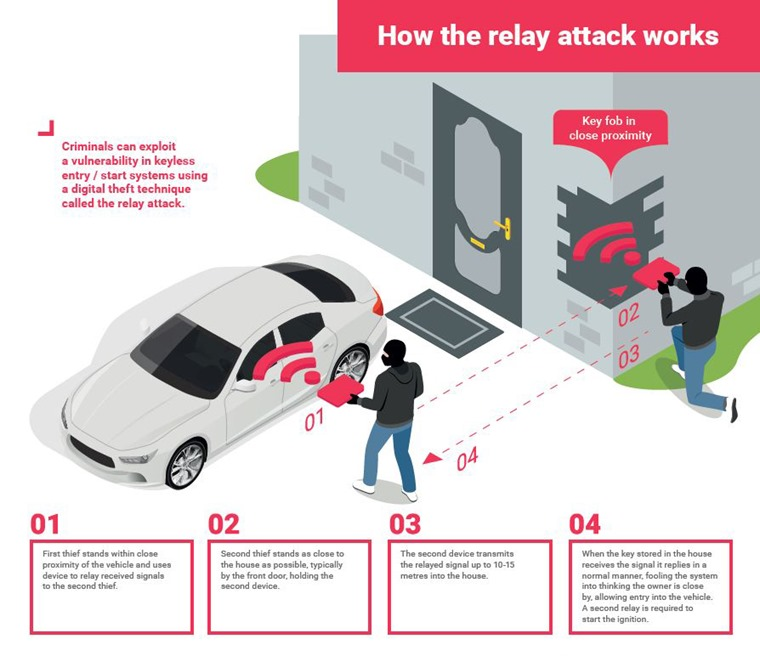
These tools are cheap, portable and widely available online, which is why theft rates remain high even with modern security.
How UK Drivers Can Minimise Theft
Here are the most effective ways to stay ahead of thieves:
| How UK Drivers Can Minimise Theft | |
|---|---|
| Extra Immobiliser Layer | Adds a secret disarm step thieves cannot bypass |
| OBD Port Protection | Stops thieves programming new keys |
| Signal Blocking | Prevents relay attacks on keyless entry systems |
| Visible Deterrents | Steering locks and warnings make thieves move on |
| Driveway Cameras | Thieves avoid properties with surveillance |
Why Extra Immobilisers Are Becoming Essential
Factory security is good — but it’s predictable. Thieves know how it works.
An additional immobiliser layer adds a secret step only the owner knows. Even if thieves:
Clone the key
Boost the signal
Access the OBD port
Inject CAN‑bus commands
The engine still won’t start.
This is why extra immobilisers are becoming the go‑to defence for UK drivers who want real protection.
Free tools & guides from ManCarCoding
Keep exploring — jump straight to the useful bits
🔧 View all specialist services — key programming, ECU cloning, remaps, immobilisers & more.
🚗 Free UK reg checker — instant DVSA lookup: MOT, tax, make, model, engine.
🧠 Talk to Man-Ai — 30-year master mechanic in your pocket, 3 questions free.
💾 Check your ECU type — 1,000+ ECU coverage list, search by make/model.
🔑 Key coverage (9,000+ vehicles) — confirm we can cut & program your key before you book.


